Sourdough Bread (Beginner-Friendly)
 Prep: 16 HoursCook: 45 Minutes
12 servings
 Intermediate
Dairy-FreeVeganHigh-Fiber/Whole GrainReduced-Fat
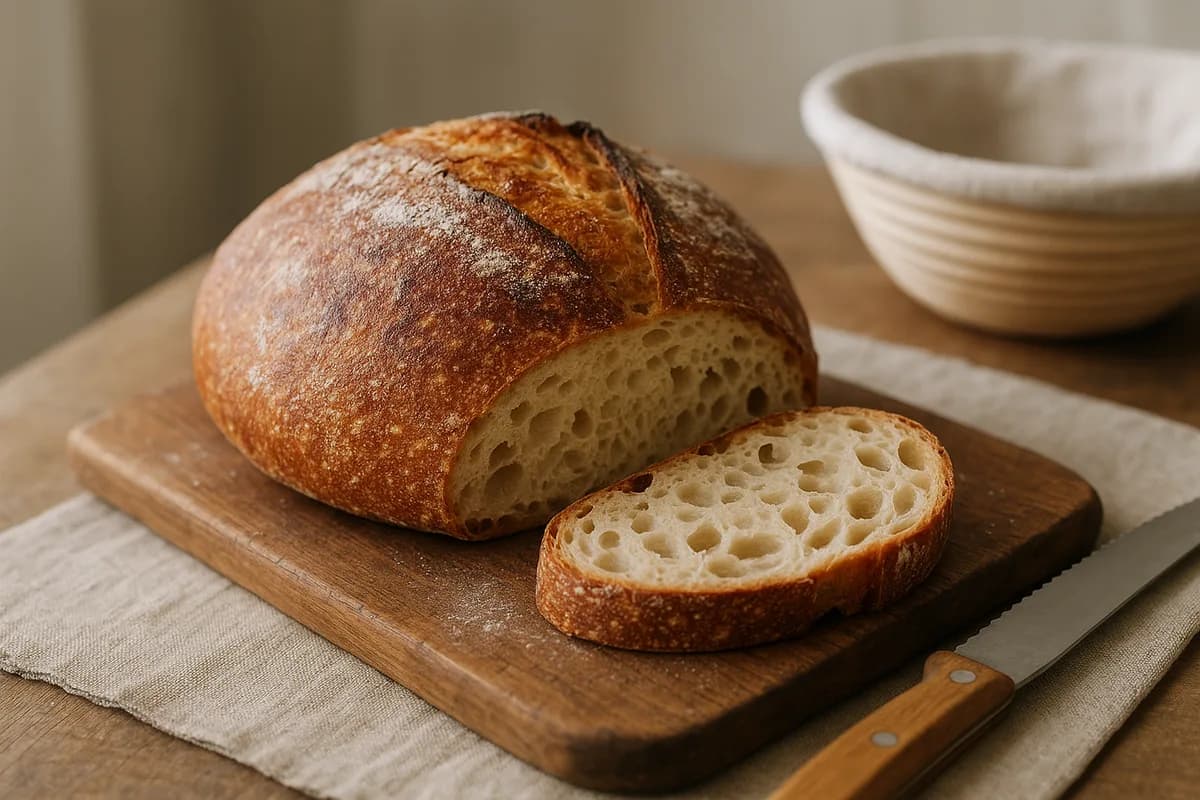
This Sourdough Bread (Beginner-Friendly) recipe delivers a crusty, tangy artisan-style loaf with a simple, relaxed schedule. Using active sourdough starter, bread flour, whole wheat flour, water, and salt, this homemade starter bread is naturally leavened, dairy-free, and vegan. Follow the clear folds-and-rests method and overnight chill for a deeply flavored, crackling crust and tender, chewy crumb—perfect for anyone starting their sourdough bread journey.
Calories: 180 kcalProtein: 6 gCarbs: 37 gFat: 1 g
Prep16 Hours
Rise/Proof23 Hours 50 Minutes
Bake45 Minutes
Servings12
DifficultyIntermediate
Ingredients
Baker's Essentials for this Recipe
Shop the gear that makes this recipe easier to bake.
Steps
- In a large bowl, combine the bread flour and whole wheat flour. Add 320 g of the water (about 20–22°C / 68–72°F) and mix with your hand or a dough whisk until no dry flour remains and the dough looks shaggy. Cover and rest for 30 minutes (autolyse).
- Add the sourdough starter and fine sea salt to the dough, along with the remaining 50 g water. Pinch and squeeze the dough repeatedly, then fold it over itself until the starter and salt are evenly incorporated and the dough feels cohesive and slightly elastic, about 3–5 minutes.
- Cover the bowl and let the dough rise at about 24–26°C (75–79°F) for 3–4 hours (bulk fermentation). During the first 2 hours, perform 3–4 sets of stretch-and-folds every 30 minutes: grab one edge of the dough, stretch it upward, and fold it over the center, rotating the bowl and repeating 4–6 times per set. The dough should gradually become smoother, more elastic, and slightly puffy.
- After bulk fermentation, lightly flour your work surface with a little bread flour. Gently turn the dough out, keeping as much gas in the dough as possible. Using a bench scraper, pre-shape the dough into a loose round by tucking the edges underneath. Cover and let rest for 20–30 minutes until the surface looks slightly relaxed but still holds shape.
- Dust a proofing basket or a medium bowl lined with a clean towel generously with the rice flour so the dough will not stick. Shape the dough into a tighter round: flip it seam-side up, gently stretch the top edge away from you and fold it to the center, then repeat with the sides and bottom. Flip seam-side down and use the bench scraper to drag the dough toward you, tightening the surface until it is smooth and taut.
- Place the shaped dough seam-side up into the prepared basket. Cover well and refrigerate for 8–16 hours for a cold proof. During this time the dough will slowly rise, develop flavor, and the surface will become slightly domed and firm to the touch.
- When you are ready to bake, place a Dutch oven with its lid on into your oven and preheat to 220°C (425°F). Let the Dutch oven heat for at least 30 minutes so it is thoroughly hot before baking. Keep the dough refrigerated during this preheating time.
- Carefully remove the hot Dutch oven from the oven and take off the lid. Gently invert the chilled dough from the basket onto a piece of parchment paper so it is now seam-side down. Using a sharp lame or serrated knife, score the top with a 1–2 cm deep slash to control expansion.
- Using the parchment as a sling, lower the scored dough into the hot Dutch oven. Cover with the lid and bake at 220°C (425°F) for 20 minutes to allow the loaf to rise and steam, helping create an open, chewy crumb and thin crackling crust.
- After 20 minutes, remove the lid and continue baking at 220°C (425°F) for another 20–25 minutes, or until the crust is deep golden brown, the loaf feels firm, and the bottom sounds hollow when tapped. For extra accuracy, the internal temperature should reach about 96–99°C (205–210°F). The crust should be crisp, and the loaf should look well expanded with an attractive ear along the score.
- Carefully lift the bread out of the Dutch oven and transfer it to a wire rack. Let cool for at least 1 hour before slicing so the crumb sets properly. When sliced, the interior should be moist, slightly glossy, and open-crumbed with irregular holes, while the crust remains pleasantly chewy and crackly.